
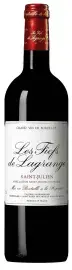
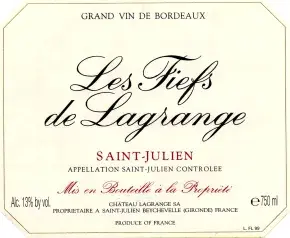
Les Fiefs de Lagrange - 2016
Les Fiefs de Lagrange - 2016
Blend
55% Cabernet Sauvignon
41% Merlot
4% Petit Verdot
41% Merlot
4% Petit Verdot
Country
France
Region
Bordeaux
Appellation
Saint-Julien
UPC
0 15643 54775 1
0 15643 72748 1

Ageing
Air conditioned cellars with regulated hygrometry.
20 % of new oak barrels every year for Les Fiefs de Lagrange, maturing for 14 months.
Maturing with the bung on top for about 6 months (3 top-ups per week).
Supplementary maturing with the bung on the side with racking every 3 months.
Fining with fresh egg-white in vats.
Final blending before bottling.
20 % of new oak barrels every year for Les Fiefs de Lagrange, maturing for 14 months.
Maturing with the bung on top for about 6 months (3 top-ups per week).
Supplementary maturing with the bung on the side with racking every 3 months.
Fining with fresh egg-white in vats.
Final blending before bottling.
Tasting notes
Dark and purple color, it has a very intense bouquet, with pure
black cherry, creme de cassis and crushed violets. The palate has
crisp acidity, quite tensile in the mouth and lively. One of the best
succeed of Les Fiefs de Lagrange ever, vibrant wine well
balanced.
Vinification
The contents of vats are selected according to the grape
varieties, the age of the vines, the « terror » and the maturity.
102 vats : 220hl to 36hl stainless steel vats with cooling control.
Moderate pumping-over everyday; pigeage and pumping over.
Maceration of 15 days to 22 days.
Selection of free-run wine and of press win.
Fermentation malolactic by co-inoculation.
Blending selection of the « Grand Vin » (Chateau Lagrange) and the second wine (Les Fiefs de Lagrange) in February, following the harvesting.
Average age of the vine producing les Fiefs de Lagrange: 35 years old.
Moderate pumping-over everyday; pigeage and pumping over.
Maceration of 15 days to 22 days.
Selection of free-run wine and of press win.
Fermentation malolactic by co-inoculation.
Blending selection of the « Grand Vin » (Chateau Lagrange) and the second wine (Les Fiefs de Lagrange) in February, following the harvesting.
Average age of the vine producing les Fiefs de Lagrange: 35 years old.
Vintage
The rainy spring weather encouraged the budburst although we
cannot say this was an early vintage. The flowering took place the
driest week of the spring. And 2016 was one of the hottest and driest
summers ever.
Late and long harvest: from Oct 3rd to Oct 24th. (21 days)
Hand picking into individual crates for the 111 hectares.
120 pickers on average recruited according to the daily needs by a specialised agency, allowing a
considerable flexibility of harvest to optimize the ripeness.
Last sorting grape by grape with an optical camera.
The wine
The second wine of the property was established in 1985 following the acquisition by Suntory group.
It comes from vines that average 30 years old today and planted on gravelly soils for fine Cabernet Sauvignon and Merlot for some clay.
He received the same care as the Grand Vin, with a search for maturity and concentration in the vineyard, a plot vinification and aging adapted to its tannic structure.
The wine is characterized by round tannins, aromas of red and black fruits on his youth and still shows good potential
He received the same care as the Grand Vin, with a search for maturity and concentration in the vineyard, a plot vinification and aging adapted to its tannic structure.
The wine is characterized by round tannins, aromas of red and black fruits on his youth and still shows good potential
Tasting notes
Dark and purple color, it has a very intense bouquet, with pure
black cherry, creme de cassis and crushed violets. The palate has
crisp acidity, quite tensile in the mouth and lively. One of the best
succeed of Les Fiefs de Lagrange ever, vibrant wine well
balanced.
Ageing
Air conditioned cellars with regulated hygrometry.
20 % of new oak barrels every year for Les Fiefs de Lagrange, maturing for 14 months.
Maturing with the bung on top for about 6 months (3 top-ups per week).
Supplementary maturing with the bung on the side with racking every 3 months.
Fining with fresh egg-white in vats.
Final blending before bottling.
20 % of new oak barrels every year for Les Fiefs de Lagrange, maturing for 14 months.
Maturing with the bung on top for about 6 months (3 top-ups per week).
Supplementary maturing with the bung on the side with racking every 3 months.
Fining with fresh egg-white in vats.
Final blending before bottling.
Vinification
The contents of vats are selected according to the grape
varieties, the age of the vines, the « terror » and the maturity.
102 vats : 220hl to 36hl stainless steel vats with cooling control.
Moderate pumping-over everyday; pigeage and pumping over.
Maceration of 15 days to 22 days.
Selection of free-run wine and of press win.
Fermentation malolactic by co-inoculation.
Blending selection of the « Grand Vin » (Chateau Lagrange) and the second wine (Les Fiefs de Lagrange) in February, following the harvesting.
Average age of the vine producing les Fiefs de Lagrange: 35 years old.
Moderate pumping-over everyday; pigeage and pumping over.
Maceration of 15 days to 22 days.
Selection of free-run wine and of press win.
Fermentation malolactic by co-inoculation.
Blending selection of the « Grand Vin » (Chateau Lagrange) and the second wine (Les Fiefs de Lagrange) in February, following the harvesting.
Average age of the vine producing les Fiefs de Lagrange: 35 years old.
Vintage
The rainy spring weather encouraged the budburst although we
cannot say this was an early vintage. The flowering took place the
driest week of the spring. And 2016 was one of the hottest and driest
summers ever.
Late and long harvest: from Oct 3rd to Oct 24th. (21 days)
Hand picking into individual crates for the 111 hectares.
120 pickers on average recruited according to the daily needs by a specialised agency, allowing a
considerable flexibility of harvest to optimize the ripeness.
Last sorting grape by grape with an optical camera.